Case study · Medical simulation
Safer Healthcare
VR and haptic simulators that let anaesthetists practise safely, and measure their skill.
- Healthcare
- VR & haptics
- PhD research
Introduction
In the mid-2000s, anaesthetists learned procedures such as spinal anaesthesia the traditional way: by watching experienced colleagues, then gradually performing the procedure on real patients. Training varied a lot between hospitals, trainees got little structured feedback, and there was no reliable way to measure whether someone was ready.
The question we set out to answer was simple: could we let clinicians practise in a safe, controlled environment, and measure their skills along the way? Getting there meant more than building technology. It meant educators, clinicians and developers working as one team, so that the simulator would improve patient safety, give trainees real confidence and give educators a credible way to assess competence.
In the mid-2000s, anaesthetists learned procedures such as spinal anaesthesia by watching colleagues, then performing them on real patients. Training varied between hospitals, feedback was minimal and there was no reliable way to measure readiness. The question we set out to answer was simple: could we let clinicians practise in a safe, controlled environment, and measure their skills along the way? Answering it meant educators, clinicians and developers working as one team, for the sake of patient safety and trainee confidence.
A collaborative vision
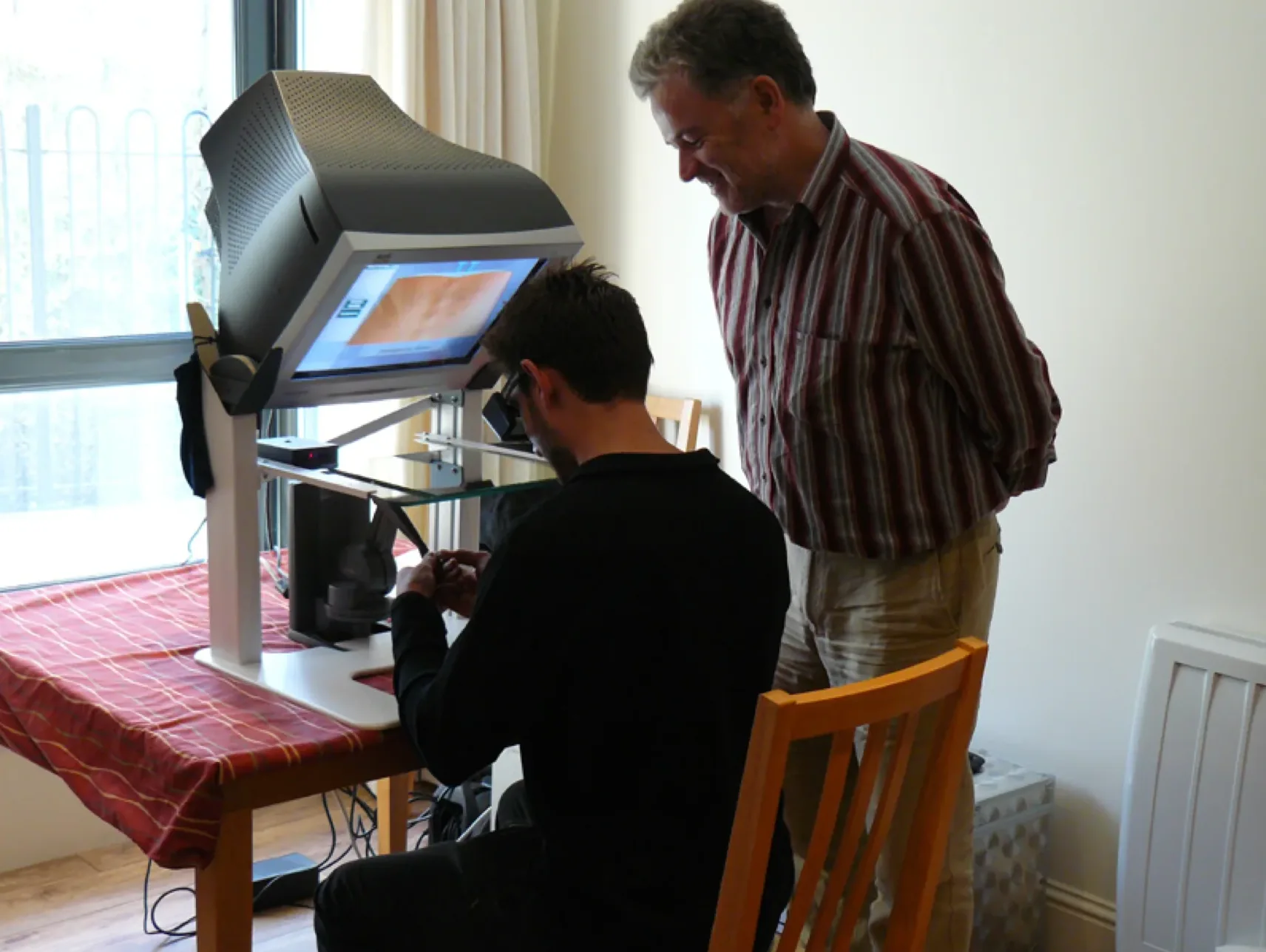
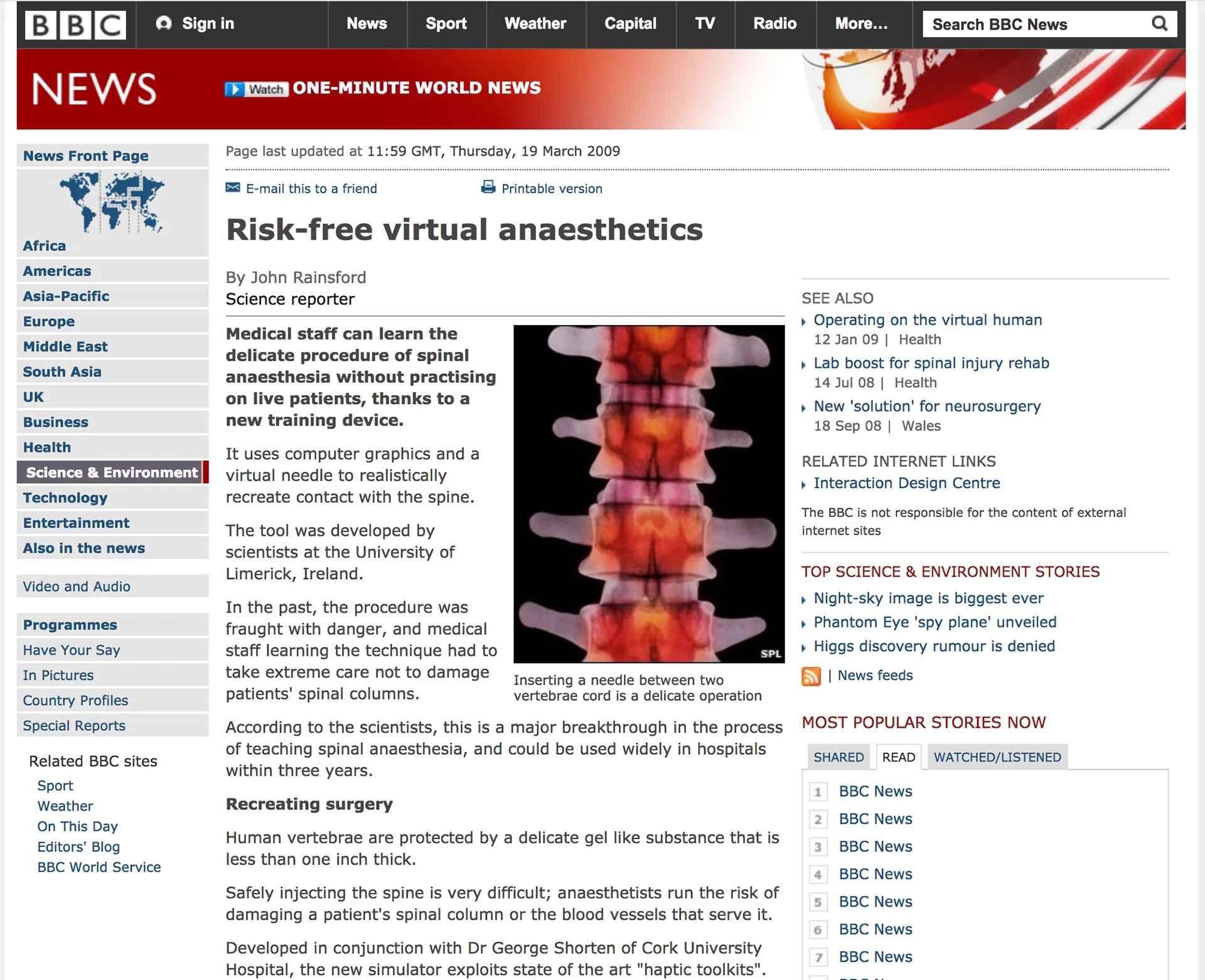
At the Interaction Design Centre (IDC), University of Limerick, I partnered with Cork University Hospital and the University of Graz to develop a series of VR-based medical simulators, starting with spinal anaesthesia.
The team brought together anaesthetists, software developers, cognitive scientists and designers. From the start, our goal was a simulator that not only felt realistic but could also be validated against real clinical performance.
At the Interaction Design Centre, University of Limerick, I partnered with Cork University Hospital and the University of Graz to develop VR-based medical simulators, starting with spinal anaesthesia. The team brought together anaesthetists, software developers, cognitive scientists and designers, with the goal of a simulator that felt realistic and could be validated against real clinical performance.
The needle trajectory: crucial medical knowledge for designing the system.
My role and approach
I led the design and development of the systems, working iteratively and in close contact with the clinicians who would use them.
I began by learning the procedure from the anaesthetists: the steps, the decisions and, above all, what it feels like as the needle passes through each layer of tissue. That feel is what trainees struggle with most, so I built haptic interfaces that let them sense the resistance of skin, ligaments and the dura as they advanced the needle.
Together with the clinicians, we then defined what good performance looks like and built ways to measure it, including accuracy, timing and safety. Finally, we ran controlled studies comparing how people performed in the simulator with their clinical experience, to check that the simulator actually measured real skill.
I led the design and development, working iteratively and closely with the clinicians. I began by learning the procedure from the anaesthetists, above all what it feels like as the needle passes through each layer of tissue, and built haptic interfaces that recreate that feel. Together with the clinicians we defined what good performance looks like, measured it, and ran controlled studies to check that the simulator measured real skill.
What we built
The work resulted in a VR simulator where trainees could practise spinal anaesthesia as many times as they needed, without any risk to patients. It was later extended with an adaptive assessment system that adjusted scenarios to each trainee's performance, and a web-based system that let supervisors follow their trainees' progress remotely.
Because simulator scores reflected real clinical performance, the system could be used for assessment as well as training, which made it a credible candidate for medical curricula.
The work resulted in a VR simulator where trainees could practise spinal anaesthesia as many times as they needed, without any risk to patients. It was extended with adaptive assessment and remote progress tracking for supervisors, and because simulator scores reflected real clinical performance, it could be used for assessment as well as training.
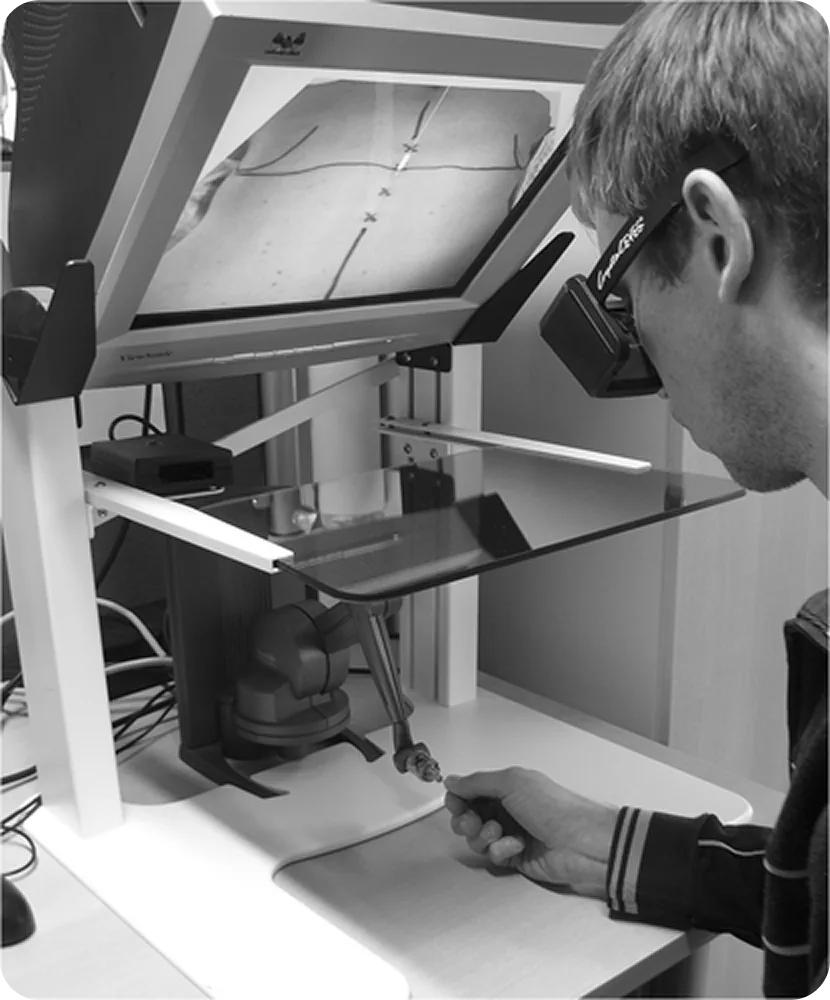
Haptic arm with a needle and VR display
Conclusion: Value for clinicians and patients
For anaesthetists and the doctors training them, the simulator delivered what traditional training could not: a safe place to practise spinal anaesthesia as often as needed, with feedback on every attempt and no risk to patients. In our evaluation with medical interns, those trained on the simulator performed as well in the operating theatre as those trained the traditional way, and scored higher on the overall rating of their clinical performance.
Just as important, we showed how tools like this should be built. Effective VR training cannot be created in silos: pedagogy has to drive the technology, and developers need to align what is technically possible with the learning goals of educators and the safety requirements of clinicians. Prototypes became our bridge across the language and culture gap between engineers and doctors, the gap that causes so many simulation projects to fail or end up unused. And by embedding the simulator in structured assessment, combining exams, simulator data and expert judgement, it became a real part of training rather than an engaging novelty.
The research became my PhD in Applied User Research (2010) and was recognised with the Irish Clinical Researcher of the Year award in 2008.
The simulator gave anaesthetists a safe place to practise spinal anaesthesia as often as needed, with no risk to patients, and interns trained on it performed as well in theatre as those trained traditionally, scoring higher on overall clinical performance. It worked because pedagogy drove the technology: prototypes bridged the gap between engineers and doctors, and structured assessment made the simulator a real part of training rather than a novelty. The research became my PhD in Applied User Research (2010) and was recognised with the Irish Clinical Researcher of the Year award in 2008.
Publications
- Journal articlePreliminary evaluation of a virtual reality-based simulator for learning spinal anesthesiaRead
- Journal articleVirtual reality-based medical training and assessment: The multidisciplinary relationship between clinicians, educators and developersRead
- Journal articleTesting haptic sensations for spinal anesthesiaRead
- PhD thesisUser Roles and User Guidance: Analysing the Relation between User Participation and the Development of a Medical Training SystemRead
- Conference paperApplying a web and simulation-based system for adaptive competence assessment of spinal anaesthesiaRead
- Conference paperDeveloping competence assessment procedure for spinal anaesthesiaRead
- BookSimulation-based Medical Training: A User-centred Design PerspectiveRead
- Conference paperDesigning a simulation-supported adaptive assessment system for spinal anaesthesiaRead